The gap between your artist alley table and your Etsy shop is where your income dies
Universe · · 5 min read · By Aonverse
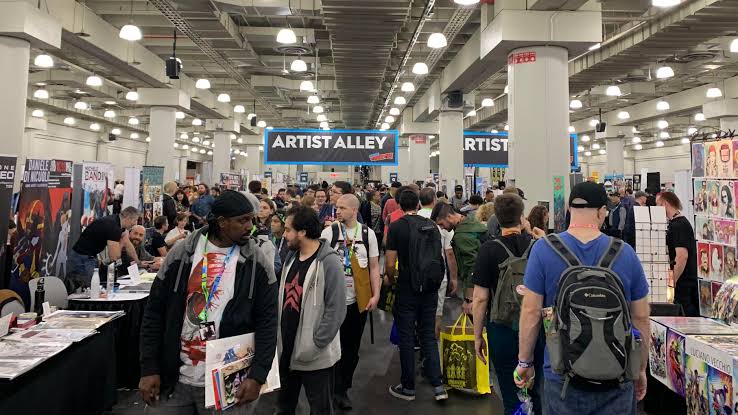
Your storefront is on Etsy, your audience is on Instagram, and the person who stood at your table in the Anime Weekend Atlanta Artist Alley and loved your work is walking away with a business card they'll lose by Sunday night. That gap, not the platform fee, is the thing quietly costing you money.
The fee argument is a decoy. You can lose a whole evening comparing a marketplace's cut against a monthly subscription against a payment processor's slice, and come out of it feeling like you made a business decision. Meanwhile the real tax gets paid in a convention hall, one person at a time, and nobody is counting it.
Here is the chain you ran last weekend. Someone stops at the table. They flip through the print bin, pull out the one with the linework they like, and say the thing that makes the whole four-day teardown worth it. Then they say they'll come back after they find their friend. You point at the QR sticker taped to the tablecloth. They scan it. It opens Instagram, which asks them to log in because they're on their phone's browser. They follow you anyway. Later, in the hotel, they tap the link in your bio. That opens a link page with five options. One of them is your shop. The shop asks them to make an account, then asks for their email twice, then loads a shipping calculator.
That is seven doors between a person wanting your work and owning it. People leave at doors.
Count the taps, then look at the percentage again
Before you change platforms, run the audit. Open your phone, pretend to be the stranger at your table, and walk your own path from QR sticker to completed checkout. Count every tap, every app switch, every login wall, every moment where your name appears as a handle instead of as you. Write the number down.
Now put that number next to the cut you've been agonizing over. A marketplace taking a percentage of a sale you made is a visible cost on a visible statement. The buyer who closed the tab at door five appears nowhere, costs nothing on paper, and is gone. You obsess over the fee because the fee is the only part you can see.
So the question worth carrying into your next platform decision is how many doors stand between wanting and having. Everything else is arithmetic on sales you already closed.
The Artist Alley hands you intent, and the handoff gives it straight back
Anime Weekend Atlanta runs an Artist Alley, and their Artist Alley page is where you'll find the particulars on tables and how applications work. What matters here is the room itself.
Think about who is standing in it. These people bought a badge. Most of them booked a hotel, drove in, waited in a line, and then chose to spend hours walking a hall of independent artists rather than doing any of the twenty other things the weekend offers. They came down the aisle on purpose, looking for work by people whose names they don't know yet. No ad budget buys that. No follow-for-follow campaign manufactures it.
And it spoils fast. Call it the length of the weekend. By Monday the badge is on a shelf, the tote is in a closet, and your card is in the drawer with the hotel keycard and four other artists' cards, all of which looked essential on Saturday and look like strangers by Wednesday.
Use the window while it's open. One free change for your next con: stop reciting your handle and start naming where the work lives. Instead of "I'm @ with three underscores," try saying "I'm Rin Castellanos, same page for the art and the shop." A sentence a person can repeat to their friend in the elevator without squinting at a card. Make your name the destination, because your name is the only thing they'll still remember on Tuesday.
Daily posting is rent you pay to reach people who already chose you
Most general platforms run on one unspoken deal: post constantly or disappear. And the disappearing happens first with your own followers, the ones who came home from the con, searched your name on purpose, hit follow, and then stopped seeing you because you spent three weeks heads-down finishing a commission queue and a convention print run.
That arrangement punishes the exact behavior that makes you worth following. Deep work looks like silence, and silence reads to the feed as abandonment.
Aonverse is built for sellers who'd rather skip that deal. Your profile works as a persistent storefront, which means you can sell without feeding a daily-posting habit, and distribution runs on word of mouth instead of recency. In practice: the person who picked up a charm at your table in October can land on the same page in February, still stocked, still yours, whether or not you posted through the holidays.
One home instead of four tabs
At the moment your identity, your audience, your shop, and your convention life sit in four accounts that refuse to speak to each other, and you are the integration layer. You're the one updating the bio link the night before load-in, reposting the restock announcement in three places, and manually reminding people who follow you in one app that you exist in another.
Aonverse collapses that. It's a social network built for creators, by creators, and it connects online fandom communities with the real-world side of this life, conventions, mixers, creative events, inside the same place where the community, the marketplace, and the monetization already live. There's gamified participation, AI-assisted creativity, and it's privacy-first, which here means your audience isn't the product being sold to advertisers to keep the lights on.
What that adds up to is nothing getting handed off. The identity a fan meets across your table is the identity that holds your shop. Same name, same page, no chain of doors between them.
Run this count two weeks after your next con
Sit down fourteen days after load-out and count how many people who stopped at your table you can still reach on purpose. Not the follower bump, not the weekend's impressions. People you could tell today, directly, that the new acrylic charms are up and shipping Thursday.
If that number sits well below the number of people who stopped, your work did its job and the workflow dropped the catch. That part is fixable.
You can see what one home looks like at aonverse.com.